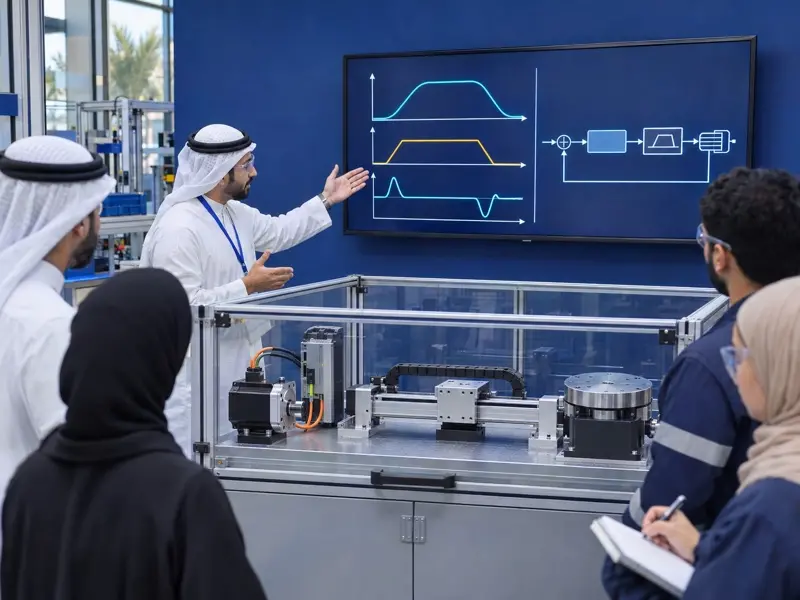
Automotive Vehicle Control Systems Engineering Training Course

Course Details
-
# 2154_257766
-
10 – 14 October 2027 14.Oct.2027
-
Doha
-
7000 €
Overview
Automotive Vehicle Control Systems Engineering Training Course is a one-week intermediate programme for automotive, vehicle systems, control, calibration and test engineers. Participants build a Vehicle Control Function Design and Validation Pack that joins vehicle control systems course principles, vehicle dynamics control, automotive feedback control, electronic stability control, vehicle control system validation and functional-safety evidence. Agile Leaders Training Center presents automotive control engineering practice.
The course treats a control function as a complete closed-loop system rather than isolated software. Participants connect driver demand, environment, vehicle states, sensors, estimators, controllers and actuators to measurable behaviour, calibration decisions, safety constraints and validation evidence.
Who Should Attend
- Automotive and vehicle-systems engineers responsible for control functions
- Control engineers developing feedback, feedforward and state-estimation logic
- Calibration engineers tuning chassis, powertrain or motion-control functions
- Test and validation engineers planning model, bench and vehicle evidence
- Technical managers coordinating system, software, hardware and safety teams
Participants should understand basic dynamics, signals and feedback-control concepts. The course does not replace vehicle-specific design authority, production software qualification, local homologation or a full ISO 26262 certification programme.
Departments and Industries
- Vehicle manufacturers and automotive engineering centres
- Tier-one and component suppliers
- Electric-vehicle, commercial-vehicle and mobility technology companies
- Automotive test laboratories and proving grounds
- Research institutes and engineering consultancies
Learning Objectives
- Define vehicle-control objectives, boundaries, interfaces and measurable performance criteria.
- Develop simplified longitudinal, lateral and actuator models for control design.
- Select sensors and construct state-estimation and signal-conditioning logic.
- Design and tune feedback, feedforward and supervisory control structures.
- Integrate safety mechanisms, diagnostics, degradation and fault responses.
- Complete a Vehicle Control Function Design and Validation Pack with traceable evidence.
Course Agenda
Day 1: Architect the Vehicle Control Function
- Vehicle Axes, States, Inputs and Responses Reference Model
- Driver, Environment, Plant, Controller and Actuator Boundary Diagram
- Control Objective, Constraint and Performance Metric Register
- Longitudinal, Lateral, Vertical and Powertrain Function Map
- System Interface, Operating Mode and Supervisory-State Model
Day 2: Model Dynamics and Estimate States
- Longitudinal Force, Speed and Acceleration Model
- Lateral Bicycle Model, Yaw and Sideslip Concepts
- Tyre, Brake, Steering, Motor and Engine Actuator Characteristics
- Wheel Speed, Acceleration, Yaw and Steering Sensor Chain
- Filtering, Plausibility, Fusion and State-Estimation Plan
Day 3: Design and Tune Control Loops
- Feedback, Feedforward, Cascade and Supervisory Architecture
- Reference Tracking, Disturbance Rejection and Constraint Handling
- Gain Selection, Stability, Transient Response and Robustness Review
- Sampling, Delay, Quantisation, Saturation and Anti-Windup Effects
- Calibration Map, Parameter Governance and Variant Strategy
Day 4: Apply Chassis and Motion Control
- Anti-Lock Braking and Wheel-Slip Control Logic
- Traction, Torque Coordination and Longitudinal Control
- Yaw Stability, Brake Intervention and Electronic Stability Control
- Steering Assistance, Lateral Control and Path-Tracking Concepts
- Integrated Chassis Control and Function-Interaction Analysis
Day 5: Assure Safety and Validate Performance
- Hazard, Safety Goal and Functional-Safety Interface Review
- Diagnostic Coverage, Fault Detection and Degraded-Mode Strategy
- Model-in-the-Loop, Software-in-the-Loop and Hardware-in-the-Loop Plan
- Vehicle Test, Scenario, Acceptance and Regression Matrix
- Capstone Exercise: Complete a Vehicle Control Function Design and Validation Pack
Practical Exercises
- Create a closed-loop architecture for a speed or stability-control function.
- Build a simplified plant and sensor model with assumptions and limitations.
- Compare controller responses under disturbance, delay and saturation.
- Develop a fault response and degraded-mode concept.
- Plan staged verification from simulation to proving-ground evidence.
FAQs
Who should attend a vehicle control systems course?
It suits engineers and technical leaders who design, calibrate, integrate, test or govern automotive motion and powertrain control functions.
Does the course focus only on electronic stability control?
No. Stability control is one application within a broader framework that includes dynamics, sensing, estimation, longitudinal and lateral control, actuators, diagnostics and validation.
What mathematics is required?
Participants benefit from basic differential equations, signals and feedback concepts, but the course emphasizes system reasoning, models, decisions and validation rather than lengthy derivations.
How is functional safety included?
The course connects hazards, safety goals, failure detection, degraded modes and verification evidence to control-function development without claiming full certification training.
What validation methods are covered?
Participants plan model-in-the-loop, software-in-the-loop, hardware-in-the-loop, bench and vehicle testing using traceable scenarios, acceptance criteria and regression evidence.
Conclusion
Participants leave with an integrated engineering method and a completed design-and-validation pack. They can connect dynamics, estimation, control, calibration, safety and testing into traceable vehicle behaviour.
Maintenance Training and Engineering Training Courses
Automotive Vehicle Control Systems Engineering Course (2154_257766)
Course Details
# 2154_257766
10 – 14 October 2027
Doha
Fees : 7000 €
Automotive Vehicle Control Systems Engineering Training Course runs in Doha over 5 days, with 1 upcoming date in Doha. The course fee is 7,000 €.
All dates in Doha
| Dates | Price | Actions |
|---|---|---|
| 10 – 14 October 2027 | 7,000 € | Register |
Training in Doha
Experience our top-notch training courses programs in the vibrant city of Doha, Qatar. Participate in our professional training courses. Join Today !
All courses in DohaThis course in other cities
- Abu Dhabi
- Accra
- Addis Ababa
- Amman
- Amsterdam
- Athens
- Baku
- Bali
- Bangkok
- Barcelona
- Berlin
- Cairo
- Cape town
- Casablanca
- Chicago
- Dubai
- Frankfurt
- Geneva
- Istanbul
- Jakarta
- Johannesburg
- Kuala Lumpur
- Kuwait
- Lagos
- Langkawi
- Lisbon
- London
- Madrid
- Manama
- Marbella
- Milan
- Montreux
- Munich
- Muscat
- Nairobi
- New York
- Nice
- Paris
- Phuket
- Porto
- Prague
- Rome
- San Diego
- Seoul
- Sharm El-Sheikh
- Singapore
- Tashkent
- Tbilisi
- Tokyo
- Toronto
- Trabzon
- Vienna
- Zanzibar
- Zoom