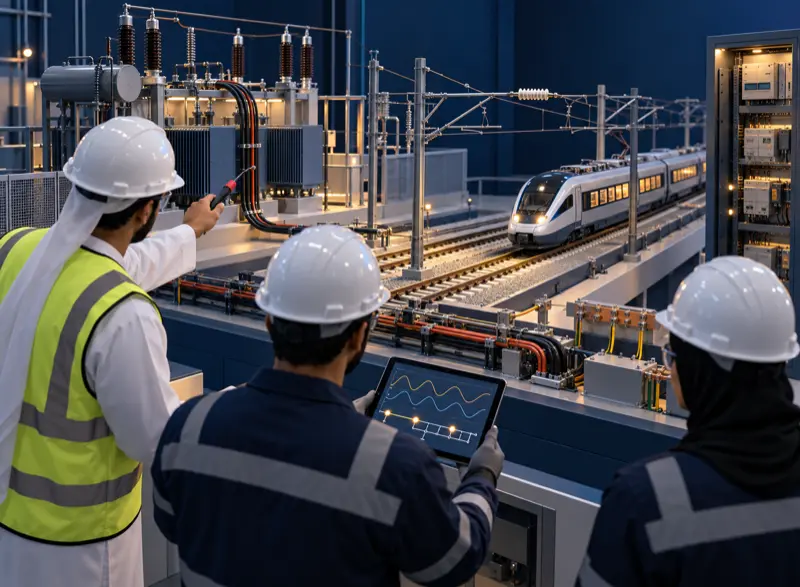
Power Cable Engineering: Design, Manufacturing, Standards and Testing Course – Bangkok, 16–20 May 2027

Course Details
-
# 2242_263891
-
16 – 20 May 2027 20.May.2027
-
Bangkok
-
8000 €
This session: 16–20 May 2027
This Power Cable Engineering: Design, Manufacturing, Standards and Testing Course session in Bangkok runs from Sunday 16 May to Thursday 20 May 2027 (week 19, Q2 2027). It is the only date in Bangkok in 2027, at a fee of 8,000 €. Registration is open for this date. It is held in person.
- Dates
- Sunday 16 May – Thursday 20 May 2027
- Week
- 19 of 2027
- Duration
- 5 days
- Fee
- 8,000 €
- Status
- Open for registration
- Format
- In person
Overview
The Power Cable Engineering: Design, Manufacturing, Standards and Testing Course is a one-week course for electrical engineers, cable system designers, and quality assurance inspectors who leave with a cable engineering technical dossier to govern procurement and production assurance. Unclear material specifications, uncontrolled curing defects, and inadequate factory testing protocols cause costly cable breakdowns and project delays. This course resolves technical vulnerabilities through rigorous application of IEC 60228 conductor design, continuous vulcanization manufacturing oversight, and IEC 60502 partial discharge acceptance criteria. Agile Leaders Training Center delivers the Power Cable Engineering: Design, Manufacturing, Standards and Testing Course.
Who Should Attend
- Electrical design engineers responsible for cable sizing, insulation coordination, and conductor selection.
- Quality assurance managers overseeing factory acceptance testing, continuous vulcanization lines, and vendor auditing.
- Transmission and distribution project engineers supervising high-voltage cable route installation and technical procurement.
- Plant maintenance engineers directing medium- and high-voltage cable condition assessment and diagnostic testing.
- Commissioning specialists managing site acceptance testing and baseline dielectric dissipation verification.
The course assumes participants actively manage industrial power systems or electrical infrastructure projects, and it leaves out residential building branch wiring and low-voltage domestic installations.
Departments and Industries
The course draws operational cases from infrastructure management and resources sectors.
- High-voltage electrical transmission and distribution utilities
- Heavy petrochemical processing and offshore refining plants
- Renewable energy generation and substation engineering facilities
- Industrial manufacturing and continuous process operations
- Engineering, procurement, and construction contracting divisions
Learning Objectives
By the end of this course, participants will be able to:
- Apply IEC 60228 conductor sizing and DC resistance calculations to optimize power core construction.
- Build continuous catenary vulcanization and triple-extrusion quality control parameters for insulated power cables.
- Evaluate routine and type testing data using IEC 60502-2 and IEC 60840 criteria.
- Diagnose insulation aging mechanisms and dielectric breakdown using partial discharge and Tan delta measurements.
- Prioritize factory acceptance testing protocols to audit supplier manufacturing runs and documentation.
- Formulate a cable engineering technical dossier governing procurement specifications and qualification testing.
Course Agenda
Day 1: Conductor Design and Cable Construction Foundations
- Conductor materials and resistance thresholds under IEC 60228
- Solid versus stranded Class 1, Class 2, and flexible Class 5 conductor geometry
- Metallic screening design using copper tape and wire screen architectures
- Outer sheath polymer selection including PVC, HDPE, LLDPE, and low-smoke zero-halogen jackets
- Thermal rating and short-circuit current capacity calculation methods
Day 2: Insulation Systems and Vulcanization Manufacturing
- Triple-extrusion head tooling for conductor screen, XLPE insulation, and insulation screen
- Continuous catenary vulcanization and vertical continuous vulcanization line thermal zones
- Degasification chamber residence times for methane and acetophenone byproduct removal
- Cross-linking percentage verification using hot set elongation tests under IEC 60811
- Extruder screw temperature profiling and peroxide decomposition dynamics
Day 3: Standards Compliance and High-Voltage Specifications
- Low-voltage extruded cable construction rules under IEC 60502-1:2021
- Medium-voltage cable requirements and accessories under IEC 60502-2:2014+AMD1:2024 CSV
- High-voltage system specifications from 30 kV up to 150 kV under IEC 60840
- Extra-high-voltage cable systems and long-term testing parameters under IEC 62067:2022
- Cable termination and jointing interface standards up to 36 kV
Day 4: Factory Acceptance Testing and Diagnostic Evaluation
- Routine partial discharge screening thresholds of 10 pC and 5 pC under high-voltage pre-stress
- Dielectric dissipation factor Tan delta measurement across voltage ranges from 0.5 to 2.0 U0
- High-voltage AC withstand test procedures and spark testing for protective jackets
- Lightning impulse breakdown testing setups using 1.2/50 microsecond impulse waveforms
- Heating cycle voltage endurance tests operating at 90 to 95 degrees Celsius
Day 5: Testing Bay Execution and Quality Assurance Practice
- Suggested activity: Audit a continuous catenary vulcanization extrusion log for curing anomalies
- Suggested activity: Analyze partial discharge test bay oscillograms against IEC 60502-2 acceptance thresholds
- Suggested activity: Evaluate dielectric dissipation factor Tan delta trends across thermal step changes
- Suggested activity: Formulate a factory acceptance testing inspection checklist for high-voltage cable runs
- Capstone exercise: Assemble an integrated cable engineering technical dossier resolving manufacturing and testing specifications
Practical Exercises
The course uses manufacturing batch records, dielectric test bay datasets, and factory audit sheets.
- Suggested activity: Calculate conductor DC resistance limits and cross-sectional sizing per IEC 60228.
- Suggested activity: Evaluate XLPE hot set elongation test results against cross-linking thresholds under IEC 60811.
- Suggested activity: Interpret factory routine partial discharge test bay plots to isolate internal voids.
- Capstone exercise: Formulate a cable engineering technical dossier validating manufacturing quality and acceptance testing.
FAQs
Who suits the Power Cable Engineering: Design, Manufacturing, Standards and Testing Course?
The Power Cable Engineering: Design, Manufacturing, Standards and Testing Course suits electrical engineers, procurement specialists, and quality auditors managing power cables. The course assumes active involvement in electrical systems, leaving out domestic house wiring.
How does the Power Cable Engineering: Design, Manufacturing, Standards and Testing Course differ from field installation training?
Field installation training covers basic trenching, cable pulling, and simple termination heat shrinking. The Power Cable Engineering: Design, Manufacturing, Standards and Testing Course concentrates on core conductor design, triple-extrusion vulcanization manufacturing, IEC compliance, and factory acceptance testing protocols.
Which standards govern the Power Cable Engineering: Design, Manufacturing, Standards and Testing Course?
The Power Cable Engineering: Design, Manufacturing, Standards and Testing Course applies international standards including IEC 60228 for conductors, IEC 60502-1:2021 and IEC 60502-2:2014+AMD1:2024 CSV for medium-voltage cables, IEC 60840 for high-voltage cables, and IEC 62067:2022 for extra-high-voltage systems.
What testing protocols are addressed in the Power Cable Engineering: Design, Manufacturing, Standards and Testing Course?
The Power Cable Engineering: Design, Manufacturing, Standards and Testing Course evaluates routine and type testing including conductor resistance, high-voltage AC withstand, partial discharge measurement, dielectric dissipation factor Tan delta testing, and hot set elongation verification.
Conclusion
Participants return to their organizations equipped with a practical cable engineering technical dossier to govern procurement specifications and manufacturing surveillance. This operational asset prevents insulation failure and streamlines factory acceptance testing sign-offs. Engineering teams immediately establish rigorous quality verification across power cable production and high-voltage testing bays.
Maintenance Training and Engineering Training Courses
Power Cable Engineering Course: Design and Testing (2242_263891)
Course Details
# 2242_263891
16 – 20 May 2027
Bangkok
Fees : 8000 €
Power Cable Engineering: Design, Manufacturing, Standards and Testing Course runs in Bangkok over 5 days, with 1 upcoming date in Bangkok. The course fee is 8,000 €.
All dates in Bangkok
| Dates | Price | Actions |
|---|---|---|
| 16 – 20 May 2027 This session | 8,000 € | Register |
Training in Bangkok
Explore diverse courses in bustling Bangkok—Thailands heart of culture, innovation, and endless opportunities for learning growth!
All courses in BangkokThis course in other cities
- Abu Dhabi
- Accra
- Addis Ababa
- Amman
- Amsterdam
- Athens
- Baku
- Bali
- Barcelona
- Berlin
- Cairo
- Cape town
- Casablanca
- Chicago
- Doha
- Dubai
- Frankfurt
- Geneva
- Istanbul
- Jakarta
- Johannesburg
- Kuala Lumpur
- Kuwait
- Lagos
- Langkawi
- Lisbon
- London
- Madrid
- Manama
- Marbella
- Milan
- Montreux
- Munich
- Muscat
- Nairobi
- New York
- Nice
- Paris
- Phuket
- Porto
- Prague
- Rome
- San Diego
- Seoul
- Sharm El-Sheikh
- Singapore
- Tashkent
- Tbilisi
- Tokyo
- Toronto
- Trabzon
- Vienna
- Zanzibar
- Zoom