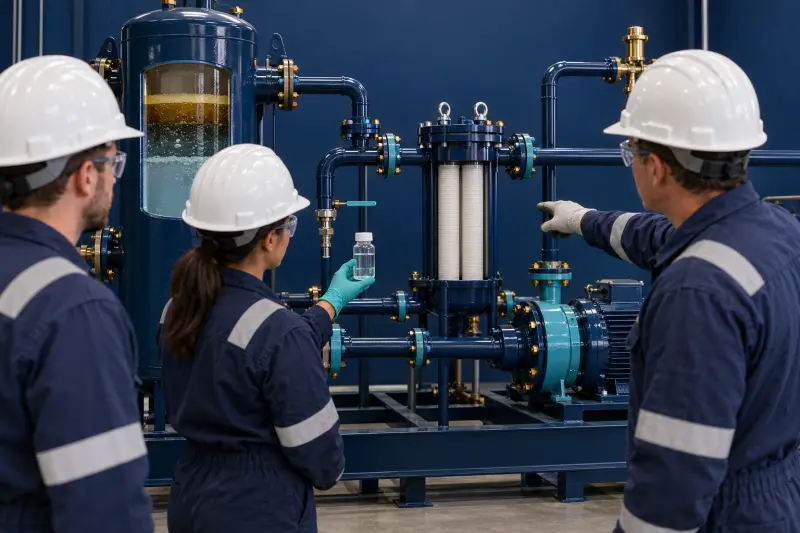
Crude Oil Treatment and Troubleshooting Course

At a glance
- Duration
- 1 Week
- Format
- Classroom
- Cities
- Trabzon, Doha, Singapore, Cairo, Istanbul, Sharm El-Sheikh and more
- Next session
- 8 – 12 November 2026, Trabzon
- Average fee
- 7,500 €
Overview
Crude Oil Treatment Operations and Troubleshooting Training Course is a one-week course for production, process, operating, laboratory, flow-assurance, and technical-assurance functions who leave with a Crude Treatment Performance and Troubleshooting File. Participants connect crude properties, emulsion behavior, separation, dehydration, desalting, stabilization, quality evidence, and operating limits. The course resolves treatment failures through trend analysis, bottle-test decisions, electrostatic-treater checks, and structured upset diagnosis. Agile Leaders Training Center presents crude oil treatment operations and troubleshooting.
Who Should Attend
- Production engineering functions responsible for crude-treatment performance and delivery specifications
- Process engineering functions responsible for separation, heating, dehydration, desalting, and stabilization
- Operations functions responsible for treatment trains, chemical injection, interfaces, and upset response
- Laboratory and quality functions responsible for crude sampling, testing, and result validation
- Flow-assurance functions responsible for wax, asphaltene, solids, foam, and emulsion behavior
- Technical-assurance functions responsible for operating envelopes, evidence, and improvement actions
The course assumes participants already interpret process-flow diagrams, operating trends, laboratory results, or crude specifications, and it leaves out reservoir engineering, artificial lift, refinery-wide integration, detailed mechanical design, produced-water treatment as the primary subject, and gas processing.
Departments and Industries
The course supports departments and industries that condition crude oil for transfer, transport, storage, or refining.
- Upstream production and surface facilities
- Crude gathering and central processing facilities
- Oil terminals and storage operations
- Refinery crude-receipt and feed-preparation functions
- Process laboratories and product-quality assurance
- Production chemicals and technical services
Learning Objectives
By the end of this course, participants will be able to:
- Build a crude-treatment target and operating-envelope basis
- Analyze emulsion stability, separation, heating, and retention effects
- Apply dehydration, desalting, wash-water, and chemical controls
- Evaluate stabilization, vapor-pressure, solids, wax, foam, and H2S risks
- Diagnose quality excursions from samples, trends, interfaces, and equipment behavior
- Prioritize energy, chemical, start-up, shutdown, and upset actions
Course Agenda
Day 1: Define Treatment Targets
- Crude Characterization and Treatment Target Sheet
- Wellstream Separation and Treatment Train Map
- BS&W, Salt, Sediment, and Vapor-Pressure Evidence Register
- ASTM D4057-22 Manual Sampling Practice Check
- Crude Treatment Operating Envelope and Constraint Log
Day 2: Control Emulsions and Dehydration
- Water-in-Oil Emulsion Stability Diagnosis Matrix
- Gravity Settling, Temperature, and Retention-Time Assessment
- Demulsifier Bottle-Test and Dosage Decision Sheet
- Electrostatic Dehydrator Field and Interface Control Map
- ASTM D4007-22 Water and Sediment Trend Review
Day 3: Operate Desalting and Stabilization
- Wash-Water Quality, Rate, and Mixing Control Plan
- Electrostatic Desalter Salt-Removal Performance Balance
- ASTM D6470-26 Crude Salt Result Interpretation
- Crude Stabilization and Vapor-Pressure Control Diagram
- Produced-Water, Slop, and Recycle Interface Register
Day 4: Troubleshoot Treatment Performance
- Solids, Wax, Asphaltene, Foam, and H2S Risk Matrix
- High BS&W and Salt Excursion Fault Tree
- Treater Interface, Carryover, Arcing, and Short-Circuit Check
- Heat, Chemical, Wash-Water, and Residence-Time Optimization Sheet
- Start-Up, Shutdown, and Treatment Upset Response Checklist
Day 5: Practice Treatment Assurance
- Suggested Exercise: Diagnose an Emulsion and Select Treatment Controls
- Suggested Exercise: Reconcile Dehydrator and Desalter Performance Trends
- Suggested Exercise: Resolve Stabilization and Quality-Specification Deviations
- Suggested Exercise: Optimize Heat, Chemical, and Wash-Water Decisions
- Capstone Exercise: Complete the Crude Treatment Performance and Troubleshooting File
Practical Exercises
The course uses suggested activities to convert crude properties, treatment conditions, test results, and failure evidence into controlled operating decisions.
- Suggested activity: classify an emulsion and compare temperature, retention, chemical, and electrostatic treatment options.
- Suggested activity: calculate a dehydration and desalting performance balance from inlet, outlet, water, and salt data.
- Suggested activity: trace a quality excursion through sampling, interfaces, chemical dosage, heating, and equipment behavior.
- Suggested activity: document start-up, shutdown, upset-response, and optimization actions inside an operating envelope.
FAQs
Who suits crude oil treatment operations training, and what does it assume?
Crude oil treatment operations training suits production, process, operating, laboratory, flow-assurance, and assurance functions. It assumes working familiarity with process diagrams, operating data, laboratory results, or crude specifications.
How does crude oil treatment training differ from produced-water treatment training?
Crude oil treatment training focuses on export-quality oil through separation, emulsion breaking, dehydration, desalting, stabilization, and quality control. Produced-water treatment training focuses on removing dispersed oil and solids from the water stream for discharge, reuse, or reinjection.
Why do crude oil emulsions resist dehydration?
Crude oil emulsions resist dehydration when small water droplets, interfacial films, fines, high viscosity, insufficient temperature, poor chemical selection, short residence time, or unstable electrostatic conditions prevent droplet coalescence and settling.
How is crude oil desalter performance monitored?
Crude oil desalter performance is monitored through inlet and outlet salt, water and sediment, wash-water quality and rate, mixing, temperature, pressure, interface level, electrical behavior, brine quality, and trend reconciliation.
How is a crude oil treatment quality excursion troubleshot?
A quality excursion is troubleshot by validating the sample, locating the first abnormal trend, checking feed properties and interfaces, testing chemical response, reviewing heat and residence time, examining electrical behavior, and recording corrective evidence.
Conclusion
Participants take back a Crude Treatment Performance and Troubleshooting File linking crude properties, targets, treatment stages, operating limits, test evidence, deviations, and corrective actions. The file changes isolated readings into a traceable treatment diagnosis. It supports more consistent quality decisions, controlled chemical and energy use, structured upset response, and documented operating assurance.
credits: 5 credit per day
Course Mode: full-time
Provider: Agile Leaders Training Center
-
Events for this Course
-
Trabzon 8 – 12 November 2026
-
Doha 15 – 19 November 2026
-
Singapore 16 – 20 November 2026
-
Cairo 23 – 27 November 2026
-
Istanbul 7 – 11 December 2026
-
Sharm El-Sheikh 14 – 18 December 2026
-
Tashkent 20 – 24 December 2026
-
Barcelona 21 – 25 December 2026
-
Langkawi 27 – 31 December 2026
-
New York 28 December 2026 – 1 January 2027
-
Phuket 10 – 14 January 2027
-
Paris 18 – 22 January 2027
-
Tokyo 25 – 29 January 2027
-
Rome 8 – 12 February 2027
-
Porto 8 – 12 February 2027
-
Kuala Lumpur 15 – 19 February 2027
-
Lisbon 15 – 19 February 2027
-
Casablanca 22 – 26 February 2027
-
Muscat 28 February – 4 March 2027
-
Munich 8 – 12 March 2027
-
Nice 15 – 19 March 2027
-
Zoom 22 – 26 March 2027
-
Milan 29 March – 2 April 2027
-
Bangkok 4 – 8 April 2027
-
Lagos 11 – 15 April 2027
-
Madrid 12 – 16 April 2027
-
London 19 – 23 April 2027
-
Geneva 25 – 29 April 2027
-
Marbella 25 – 29 April 2027
-
Kuwait 2 – 6 May 2027
-
Montreux 3 – 7 May 2027
-
Athens 10 – 14 May 2027
-
Abu Dhabi 10 – 14 May 2027
-
Cape town 16 – 20 May 2027
-
Toronto 16 – 20 May 2027
-
Frankfurt 31 May – 4 June 2027
-
Chicago 6 – 10 June 2027
-
Amman 13 – 17 June 2027
-
Baku 28 June – 2 July 2027
-
Tbilisi 5 – 9 July 2027
-
Amsterdam 12 – 16 July 2027
-
Zanzibar 18 – 22 July 2027
-
Addis Ababa 19 – 23 July 2027
-
Abu Dhabi 26 – 30 July 2027
-
Accra 1 – 5 August 2027
-
San Diego 9 – 13 August 2027
-
Bali 15 – 19 August 2027
-
Nairobi 22 – 26 August 2027
-
Jakarta 30 August – 3 September 2027
-
Dubai 6 – 10 September 2027
-
Seoul 6 – 10 September 2027
-
Vienna 27 September – 1 October 2027
-
Johannesburg 3 – 7 October 2027
-
Berlin 4 – 8 October 2027
-
Manama 10 – 14 October 2027
-
Prague 18 – 22 October 2027
-
Dubai 1 – 5 November 2027
-
London 8 – 12 November 2027
| Image | Location | Dates | Duration | Mode | Price | Actions |
|---|---|---|---|---|---|---|

|
Trabzon |
Week 45, 2026 8 – 12 November 2026 |
1 Week | Onsite | €8,000 | |

|
Doha |
Week 46, 2026 15 – 19 November 2026 |
1 Week | Onsite | €7,000 | |

|
Singapore |
Week 47, 2026 16 – 20 November 2026 |
1 Week | Onsite | €6,500 | |

|
Cairo |
Week 48, 2026 23 – 27 November 2026 |
1 Week | Onsite | €5,200 | |

|
Istanbul |
Week 50, 2026 7 – 11 December 2026 |
1 Week | Onsite | €6,000 | |

|
Sharm El-Sheikh |
Week 51, 2026 14 – 18 December 2026 |
1 Week | Onsite | €5,200 | |

|
Tashkent |
Week 51, 2026 20 – 24 December 2026 |
1 Week | Onsite | €8,000 | |

|
Barcelona |
Week 52, 2026 21 – 25 December 2026 |
1 Week | Onsite | €6,500 | |

|
Langkawi |
Week 52, 2026 27 – 31 December 2026 |
1 Week | Onsite | €8,000 | |

|
New York |
Week 53, 2026 28 December 2026 – 1 January 2027 |
1 Week | Onsite | €16,000 | |

|
Phuket |
Week 01, 2027 10 – 14 January 2027 |
1 Week | Onsite | €8,000 | |

|
Paris |
Week 03, 2027 18 – 22 January 2027 |
1 Week | Onsite | €6,500 | |

|
Tokyo |
Week 04, 2027 25 – 29 January 2027 |
1 Week | Onsite | €12,000 | |

|
Rome |
Week 06, 2027 8 – 12 February 2027 |
1 Week | Onsite | €6,500 | |

|
Porto |
Week 06, 2027 8 – 12 February 2027 |
1 Week | Onsite | €6,500 | |

|
Kuala Lumpur |
Week 07, 2027 15 – 19 February 2027 |
1 Week | Onsite | €6,500 | |

|
Lisbon |
Week 07, 2027 15 – 19 February 2027 |
1 Week | Onsite | €6,500 | |

|
Casablanca |
Week 08, 2027 22 – 26 February 2027 |
1 Week | Onsite | €6,000 | |

|
Muscat |
Week 08, 2027 28 February – 4 March 2027 |
1 Week | Onsite | €6,500 | |

|
Munich |
Week 10, 2027 8 – 12 March 2027 |
1 Week | Onsite | €6,500 |
Frequently asked questions
What does this course cover?
OverviewCrude Oil Treatment Operations and Troubleshooting Training Course is a one-week course for production, process, operating, laboratory, flow-assurance, and technical-assurance functions who leave with a Crude Treatment Performance and Troubleshooting File. Participants connect crude properties, emulsion behavior, separation, dehydration, desalting…
Are training dates available?
Yes. Available dates and destinations are listed in the course dates section on this page.
How can I register?
Choose an available date on this page and complete the registration form, or send a programme enquiry.
Can I download the course brochure?
Yes. Use the brochure download link provided on this page.
This course by city
- Oil & Gas Training and Other Technical Courses in Abu Dhabi
- Oil & Gas Training and Other Technical Courses in Accra
- Oil & Gas Training and Other Technical Courses in Addis Ababa
- Oil & Gas Training and Other Technical Courses in Amman
- Oil & Gas Training and Other Technical Courses in Amsterdam
- Oil & Gas Training and Other Technical Courses in Athens
- Oil & Gas Training and Other Technical Courses in Baku
- Oil & Gas Training and Other Technical Courses in Bali
- Oil & Gas Training and Other Technical Courses in Bangkok
- Oil & Gas Training and Other Technical Courses in Barcelona
- Oil & Gas Training and Other Technical Courses in Berlin
- Oil & Gas Training and Other Technical Courses in Cairo
- Oil & Gas Training and Other Technical Courses in Cape town
- Oil & Gas Training and Other Technical Courses in Casablanca
- Oil & Gas Training and Other Technical Courses in Chicago
- Oil & Gas Training and Other Technical Courses in Doha
- Oil & Gas Training and Other Technical Courses in Dubai
- Oil & Gas Training and Other Technical Courses in Frankfurt
- Oil & Gas Training and Other Technical Courses in Geneva
- Oil & Gas Training and Other Technical Courses in Istanbul
- Oil & Gas Training and Other Technical Courses in Jakarta
- Oil & Gas Training and Other Technical Courses in Johannesburg
- Oil & Gas Training and Other Technical Courses in Kuala Lumpur
- Oil & Gas Training and Other Technical Courses in Kuwait
- Oil & Gas Training and Other Technical Courses in Lagos
- Oil & Gas Training and Other Technical Courses in Langkawi
- Oil & Gas Training and Other Technical Courses in Lisbon
- Oil & Gas Training and Other Technical Courses in London
- Oil & Gas Training and Other Technical Courses in Madrid
- Oil & Gas Training and Other Technical Courses in Manama
- Oil & Gas Training and Other Technical Courses in Marbella
- Oil & Gas Training and Other Technical Courses in Milan
- Oil & Gas Training and Other Technical Courses in Montreux
- Oil & Gas Training and Other Technical Courses in Munich
- Oil & Gas Training and Other Technical Courses in Muscat
- Oil & Gas Training and Other Technical Courses in Nairobi
- Oil & Gas Training and Other Technical Courses in New York
- Oil & Gas Training and Other Technical Courses in Nice
- Oil & Gas Training and Other Technical Courses in Paris
- Oil & Gas Training and Other Technical Courses in Phuket
- Oil & Gas Training and Other Technical Courses in Porto
- Oil & Gas Training and Other Technical Courses in Prague
- Oil & Gas Training and Other Technical Courses in Rome
- Oil & Gas Training and Other Technical Courses in San Diego
- Oil & Gas Training and Other Technical Courses in Seoul
- Oil & Gas Training and Other Technical Courses in Sharm El-Sheikh
- Oil & Gas Training and Other Technical Courses in Singapore
- Oil & Gas Training and Other Technical Courses in Tashkent
- Oil & Gas Training and Other Technical Courses in Tbilisi
- Oil & Gas Training and Other Technical Courses in Tokyo
- Oil & Gas Training and Other Technical Courses in Toronto
- Oil & Gas Training and Other Technical Courses in Trabzon
- Oil & Gas Training and Other Technical Courses in Vienna
- Oil & Gas Training and Other Technical Courses in Zanzibar
- Oil & Gas Training and Other Technical Courses in Zoom