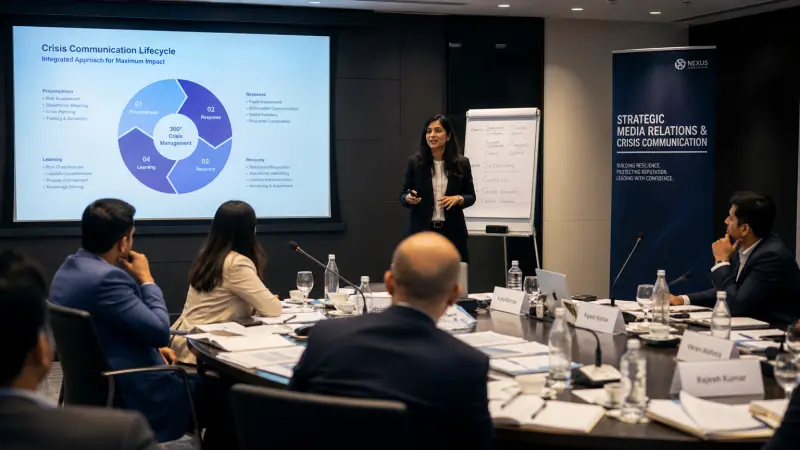
Freedom of Expression and Media Law Training Course

At a glance
- Duration
- 1 Week
- Format
- Classroom
- Cities
- Dubai, Montreux, Kuala Lumpur, Muscat, Manama, London and more
- Next session
- 9 – 13 November 2026, Dubai
- Average fee
- 5,750 €
Overview
Freedom of Expression and Legal Boundaries in Media Training Course is a one-week course for journalists, editors, media managers, communications teams, and legal and compliance advisers who leave with a Media Publication Decision File. Participants balance expression, privacy, reputation, fair-trial interests, confidentiality, source protection, intellectual property, verification, correction, and escalation through documented editorial controls. Agile Leaders Training Center develops freedom of expression and media publication decision practice.
Who Should Attend
- Editorial functions responsible for deciding whether and how material is published
- Journalism functions responsible for verification, source handling, and public-interest reporting
- Media management functions responsible for approval, correction, takedown, and escalation
- Communications and public relations functions responsible for public statements and digital content
- Legal and compliance functions responsible for publication-risk advice and decision records
The course assumes participants create, review, approve, or advise on public content and leaves out jurisdiction-specific legal opinions, litigation strategy, and representation.
Departments and Industries
The course supports departments that publish or govern public-facing content across media, corporate, nonprofit, education, and public-service settings.
- Newsrooms, broadcasting, and digital publishing
- Corporate communications and public relations
- Legal, compliance, risk, and governance
- Education, research, and nonprofit advocacy
- Public information and stakeholder engagement
Learning Objectives
By the end of this course, participants will be able to:
- Apply rights-based publication decision principles
- Use public-interest and proportionality tests
- Analyze defamation, privacy, and fair-trial risks
- Evaluate source, confidentiality, and verification controls
- Build correction, takedown, and escalation records
- Prioritize publication options with residual risk
Course Agenda
Day 1: Expression Rights and Publication Boundaries
- Freedom of Expression Rights Map
- Legitimate Restriction and Jurisdiction Check
- Editorial Judgment and Legal Determination Boundary
- Public Interest and Curiosity Distinction Test
- Publication Decision Responsibility Matrix
Day 2: Reputation, Privacy, and Justice Risks
- Fact, Opinion, and Allegation Classification Grid
- Defamation Risk Issue Checklist
- Privacy and Reputation Balancing Matrix
- Fair-Trial and Contempt Risk Screen
- Identification and Foreseeable Harm Assessment
Day 3: Sources, Evidence, and Content Rights
- Source Reliability and Verification Log
- Confidentiality and Source Protection Decision Record
- Evidence Sufficiency and Corroboration Test
- Copyright and Content Permission Checklist
- Quotation, Context, and Attribution Review Tool
Day 4: Digital Publication and Corrective Action
- Online and Social Media Publication Risk Map
- Headline, Image, and Metadata Review Checklist
- Comment, Link, and Third-Party Content Control
- Right of Reply and Correction Decision Pathway
- Takedown, Preservation, and Escalation Protocol
Day 5: Media Publication Decision Practice
- Exercise: Classify Fact, Opinion, and Allegation
- Exercise: Balance Expression, Privacy, and Reputation
- Exercise: Test Verification and Source Controls
- Exercise: Select Correction or Takedown Action
- Capstone Exercise: Media Publication Decision File
Practical Exercises
The course uses suggested activities to connect freedom of expression and media law with documented publication decisions.
- Suggested activity: classify statements and identify the evidence, context, rights, and foreseeable harm relevant to publication.
- Suggested activity: balance public-interest contribution against privacy and reputation using alternative publication options.
- Suggested activity: test a confidential source, corroboration record, quotation, image, and permission trail before approval.
- Suggested activity: decide whether to publish, revise, delay, correct, restrict, remove, or escalate content and record residual risk.
FAQs
Who suits freedom of expression and media law training, and what does it assume?
Freedom of expression and media law training suits professionals who create, review, approve, or advise on public content. It assumes familiarity with publication workflows and excludes jurisdiction-specific legal advice.
How does freedom of expression and media law training differ from journalism ethics training?
Freedom of expression and media law training focuses on rights, restrictions, legal-risk issues, jurisdiction checks, decisions, and records. Journalism ethics training usually focuses on professional values, conduct, independence, fairness, and accountability.
How should media teams balance freedom of expression with privacy?
Media teams should identify the expression and privacy interests, test public-interest contribution, verify information, assess identification and harm, compare less intrusive options, document approvals, and check the applicable law.
What reduces defamation risk in media publication decisions?
Defamation risk is reduced through accurate classification of fact and opinion, reliable sources, corroboration, fair context, response opportunities, careful headlines, documented editorial review, and timely correction routes.
When should online media content be corrected or removed?
Online media content should be reviewed when material is inaccurate, misleading, unlawfully disclosed, harmful beyond its public-interest value, or affected by a valid complaint. The chosen correction, restriction, preservation, removal, or escalation route requires a jurisdiction check.
Conclusion
Participants take a Media Publication Decision File back to work. It combines rights mapping, verification, risk screens, source controls, public-interest reasoning, publication alternatives, approvals, corrective actions, and residual-risk records. The file changes informal editorial judgment into a traceable basis for publishing, revising, delaying, correcting, removing, or escalating content.
credits: 5 credit per day
Course Mode: full-time
Provider: Agile Leaders Training Center
-
Events for this Course
-
Dubai 9 – 13 November 2026
-
Montreux 9 – 13 November 2026
-
Kuala Lumpur 30 November – 4 December 2026
-
Muscat 6 – 10 December 2026
-
Manama 13 – 17 December 2026
-
London 21 – 25 December 2026
-
Nice 21 – 25 December 2026
-
Amsterdam 28 December 2026 – 1 January 2027
-
San Diego 28 December 2026 – 1 January 2027
-
Nairobi 3 – 7 January 2027
-
Tokyo 4 – 8 January 2027
-
Dubai 11 – 15 January 2027
-
Madrid 18 – 22 January 2027
-
Abu Dhabi 18 – 22 January 2027
-
London 25 – 29 January 2027
-
Vienna 1 – 5 February 2027
-
New York 1 – 5 February 2027
-
Addis Ababa 8 – 12 February 2027
-
Langkawi 14 – 18 February 2027
-
Istanbul 15 – 19 February 2027
-
Cairo 22 – 26 February 2027
-
Seoul 22 – 26 February 2027
-
Marbella 28 February – 4 March 2027
-
Tashkent 7 – 11 March 2027
-
Rome 8 – 12 March 2027
-
Kuala Lumpur 15 – 19 March 2027
-
Milan 15 – 19 March 2027
-
Johannesburg 21 – 25 March 2027
-
Zanzibar 28 March – 1 April 2027
-
London 5 – 9 April 2027
-
Madrid 12 – 16 April 2027
-
Prague 12 – 16 April 2027
-
Jakarta 19 – 23 April 2027
-
Bangkok 25 – 29 April 2027
-
Amsterdam 26 – 30 April 2027
-
Dubai 3 – 7 May 2027
-
Munich 10 – 14 May 2027
-
Phuket 16 – 20 May 2027
-
Paris 17 – 21 May 2027
-
Amman 23 – 27 May 2027
-
Istanbul 24 – 28 May 2027
-
Cape town 30 May – 3 June 2027
-
Rome 7 – 11 June 2027
-
Singapore 7 – 11 June 2027
-
Abu Dhabi 14 – 18 June 2027
-
Trabzon 20 – 24 June 2027
-
Bali 27 June – 1 July 2027
-
Manama 4 – 8 July 2027
-
Berlin 12 – 16 July 2027
-
Dubai 19 – 23 July 2027
-
Cairo 26 – 30 July 2027
-
Porto 26 – 30 July 2027
-
Chicago 1 – 5 August 2027
-
Barcelona 2 – 6 August 2027
-
Geneva 8 – 12 August 2027
-
Paris 9 – 13 August 2027
-
Vienna 16 – 20 August 2027
-
Abu Dhabi 16 – 20 August 2027
-
Casablanca 23 – 27 August 2027
-
Athens 30 August – 3 September 2027
-
Sharm El-Sheikh 6 – 10 September 2027
-
Lagos 12 – 16 September 2027
-
Tbilisi 13 – 17 September 2027
-
Milan 20 – 24 September 2027
-
Accra 26 – 30 September 2027
-
Baku 27 September – 1 October 2027
-
Doha 3 – 7 October 2027
-
London 4 – 8 October 2027
-
Frankfurt 11 – 15 October 2027
-
Abu Dhabi 18 – 22 October 2027
-
Toronto 24 – 28 October 2027
-
Zoom 25 – 29 October 2027
-
Kuwait 31 October – 4 November 2027
-
Barcelona 1 – 5 November 2027
-
Amsterdam 8 – 12 November 2027
-
Lisbon 8 – 12 November 2027
| Image | Location | Dates | Duration | Mode | Price | Actions |
|---|---|---|---|---|---|---|

|
Cairo |
Week 08, 2027 22 – 26 February 2027 |
1 Week | Onsite | €4,100 | |

|
Seoul |
Week 08, 2027 22 – 26 February 2027 |
1 Week | Onsite | €10,000 | |

|
Marbella |
Week 08, 2027 28 February – 4 March 2027 |
1 Week | Onsite | €5,700 | |

|
Tashkent |
Week 09, 2027 7 – 11 March 2027 |
1 Week | Onsite | €4,500 | |

|
Rome |
Week 10, 2027 8 – 12 March 2027 |
1 Week | Onsite | €5,700 | |

|
Kuala Lumpur |
Week 11, 2027 15 – 19 March 2027 |
1 Week | Onsite | €5,200 | |

|
Milan |
Week 11, 2027 15 – 19 March 2027 |
1 Week | Onsite | €5,700 | |

|
Johannesburg |
Week 11, 2027 21 – 25 March 2027 |
1 Week | Onsite | €4,500 | |

|
Zanzibar |
Week 12, 2027 28 March – 1 April 2027 |
1 Week | Onsite | €5,500 | |

|
London |
Week 14, 2027 5 – 9 April 2027 |
1 Week | Onsite | €5,700 | |

|
Madrid |
Week 15, 2027 12 – 16 April 2027 |
1 Week | Onsite | €5,700 | |

|
Prague |
Week 15, 2027 12 – 16 April 2027 |
1 Week | Onsite | €6,000 | |

|
Jakarta |
Week 16, 2027 19 – 23 April 2027 |
1 Week | Onsite | €5,700 | |

|
Bangkok |
Week 16, 2027 25 – 29 April 2027 |
1 Week | Onsite | €6,000 | |

|
Amsterdam |
Week 17, 2027 26 – 30 April 2027 |
1 Week | Onsite | €5,700 | |

|
Dubai |
Week 18, 2027 3 – 7 May 2027 |
1 Week | Onsite | €4,500 | |

|
Munich |
Week 19, 2027 10 – 14 May 2027 |
1 Week | Onsite | €5,700 | |

|
Phuket |
Week 19, 2027 16 – 20 May 2027 |
1 Week | Onsite | €6,000 | |

|
Paris |
Week 20, 2027 17 – 21 May 2027 |
1 Week | Onsite | €5,700 | |

|
Amman |
Week 20, 2027 23 – 27 May 2027 |
1 Week | Onsite | €4,100 |
Frequently asked questions
What does this course cover?
OverviewFreedom of Expression and Legal Boundaries in Media Training Course is a one-week course for journalists, editors, media managers, communications teams, and legal and compliance advisers who leave with a Media Publication Decision File. Participants balance expression, privacy, reputation, fair-trial interests, confidentiality, source protection,…
Are training dates available?
Yes. Available dates and destinations are listed in the course dates section on this page.
How can I register?
Choose an available date on this page and complete the registration form, or send a programme enquiry.
Can I download the course brochure?
Yes. Use the brochure download link provided on this page.
This course by city
- Legal Training, Procurement and Contracting Courses in Abu Dhabi
- Legal Training, Procurement and Contracting Courses in Accra
- Legal Training, Procurement and Contracting Courses in Addis Ababa
- Legal Training, Procurement and Contracting Courses in Amman
- Legal Training, Procurement and Contracting Courses in Amsterdam
- Legal Training, Procurement and Contracting Courses in Athens
- Legal Training, Procurement and Contracting Courses in Baku
- Legal Training, Procurement and Contracting Courses in Bali
- Legal Training, Procurement and Contracting Courses in Bangkok
- Legal Training, Procurement and Contracting Courses in Barcelona
- Legal Training, Procurement and Contracting Courses in Berlin
- Legal Training, Procurement and Contracting Courses in Cairo
- Legal Training, Procurement and Contracting Courses in Cape town
- Legal Training, Procurement and Contracting Courses in Casablanca
- Legal Training, Procurement and Contracting Courses in Chicago
- Legal Training, Procurement and Contracting Courses in Doha
- Legal Training, Procurement and Contracting Courses in Dubai
- Legal Training, Procurement and Contracting Courses in Frankfurt
- Legal Training, Procurement and Contracting Courses in Geneva
- Legal Training, Procurement and Contracting Courses in Istanbul
- Legal Training, Procurement and Contracting Courses in Jakarta
- Legal Training, Procurement and Contracting Courses in Johannesburg
- Legal Training, Procurement and Contracting Courses in Kuala Lumpur
- Legal Training, Procurement and Contracting Courses in Kuwait
- Legal Training, Procurement and Contracting Courses in Lagos
- Legal Training, Procurement and Contracting Courses in Langkawi
- Legal Training, Procurement and Contracting Courses in Lisbon
- Legal Training, Procurement and Contracting Courses in London
- Legal Training, Procurement and Contracting Courses in Madrid
- Legal Training, Procurement and Contracting Courses in Manama
- Legal Training, Procurement and Contracting Courses in Marbella
- Legal Training, Procurement and Contracting Courses in Milan
- Legal Training, Procurement and Contracting Courses in Montreux
- Legal Training, Procurement and Contracting Courses in Munich
- Legal Training, Procurement and Contracting Courses in Muscat
- Legal Training, Procurement and Contracting Courses in Nairobi
- Legal Training, Procurement and Contracting Courses in New York
- Legal Training, Procurement and Contracting Courses in Nice
- Legal Training, Procurement and Contracting Courses in Paris
- Legal Training, Procurement and Contracting Courses in Phuket
- Legal Training, Procurement and Contracting Courses in Porto
- Legal Training, Procurement and Contracting Courses in Prague
- Legal Training, Procurement and Contracting Courses in Rome
- Legal Training, Procurement and Contracting Courses in San Diego
- Legal Training, Procurement and Contracting Courses in Seoul
- Legal Training, Procurement and Contracting Courses in Sharm El-Sheikh
- Legal Training, Procurement and Contracting Courses in Singapore
- Legal Training, Procurement and Contracting Courses in Tashkent
- Legal Training, Procurement and Contracting Courses in Tbilisi
- Legal Training, Procurement and Contracting Courses in Tokyo
- Legal Training, Procurement and Contracting Courses in Toronto
- Legal Training, Procurement and Contracting Courses in Trabzon
- Legal Training, Procurement and Contracting Courses in Vienna
- Legal Training, Procurement and Contracting Courses in Zanzibar
- Legal Training, Procurement and Contracting Courses in Zoom