Infrared Thermography for Condition Monitoring Training Course

Course Details
-
# 1805_235564
-
29 March – 2 April 2027 02.Apr.2027
-
Istanbul
-
6000 €
Overview
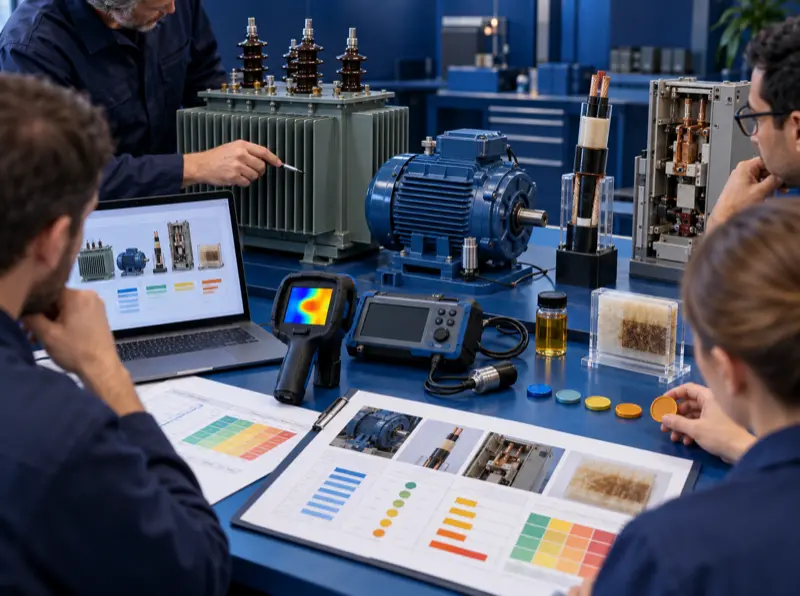
Infrared Thermography for Condition Monitoring Training Course is a one-week advanced course for maintenance, reliability, and inspection teams who leave with a Thermographic Inspection Route and Anomaly Decision Pack. The course connects thermal measurement physics, radiometric camera setup, safe field inspection, data quality, image interpretation, fault patterns, severity assessment, reporting, and maintenance decisions. Agile Leaders Training Center delivers this course on infrared thermography for condition monitoring.
Who Should Attend
- Teams responsible for condition-monitoring routes, asset criticality, and predictive-maintenance evidence
- Functions responsible for electrical, mechanical, process, and building thermal inspections
- Teams responsible for camera setup, radiometric measurements, image quality, and data control
- Functions responsible for anomaly diagnosis, severity assessment, reporting, and work prioritization
- Teams responsible for reliability review, maintenance planning, and verification of corrective actions
The course assumes participants work with industrial assets, inspection records, or maintenance decisions and leaves out live electrical work, certification assessment, medical thermography, and vendor-specific repair.
Departments and Industries
The course supports thermographic condition monitoring across maintenance, utilities, manufacturing, facilities, and process operations.
- Maintenance, reliability, inspection, technical services, and asset management
- Electrical distribution, motors, drives, rotating equipment, and utilities
- Manufacturing, food processing, metals, chemicals, and material handling
- Buildings, data facilities, healthcare estates, transport, and logistics infrastructure
- Energy, water, process plants, workshops, and field-service operations
Learning Objectives
By the end of this course, participants will be able to:
- Apply heat-transfer and radiometric measurement principles.
- Build safe, repeatable thermographic inspection routes.
- Evaluate emissivity, reflection, distance, atmosphere, and load effects.
- Diagnose electrical, mechanical, process, and building thermal patterns.
- Prioritize anomalies through evidence and severity criteria.
- Build an anomaly report and maintenance decision pack.
Course Agenda
Day 1: Establish Measurement Control
- ISO 18434-1 Thermography Procedure, Scope, Terminology, and Evidence Map
- Conduction, Convection, Radiation, Heat-Capacity, and Thermal-Gradient Model
- Qualitative, Quantitative, Comparative, Baseline, and Trending Inspection Matrix
- Target, Background, Field-of-View, Spatial Resolution, and Measurement-Spot Diagram
- Inspection Purpose, Asset Criticality, Operating State, Load, and Risk Register
Day 2: Configure and Capture Evidence
- Emissivity, Reflected Apparent Temperature, Distance, Atmosphere, and Humidity Worksheet
- Temperature Range, Level, Span, Focus, Palette, Isotherm, and Measurement-Tool Checklist
- Infrared Window, Attenuating Medium, Viewing Angle, Obstruction, and Access Plan
- Thermal Image, Visual Image, Asset ID, Load, Environment, and Timestamp Record
- Repeatability, Uncertainty, Calibration Status, Data Quality, and Rejection Log
Day 3: Interpret Asset Patterns
- Electrical Connection, Phase Comparison, Imbalance, Overload, and Contact-Resistance Pattern Card
- Bearing, Coupling, Lubrication, Alignment, Friction, and Cooling Pattern Card
- Valve, Steam Trap, Pipe, Tank, Insulation, Refractory, and Flow Pattern Card
- Envelope, Moisture, Air-Leakage, Thermal-Bridge, and HVAC Pattern Card
- True Temperature, Apparent Reflection, Transient Effect, Process Influence, and False-Positive Decision Tree
Day 4: Assess and Report Anomalies
- Baseline, Similar-Component, Phase, Load-Normalized, and Trend Comparison Sheet
- Temperature Difference, Pattern, Criticality, Consequence, Confidence, and Severity Matrix
- Finding, Evidence, Probable Mechanism, Limitation, Recommendation, and Owner Report Template
- Immediate Control, Planned Work, Monitoring Interval, Verification, and Escalation Decision Log
- Inspection Coverage, Repeat Finding, Closure, Route Effectiveness, and Review Dashboard
Day 5: Practice Thermographic Decisions
- Exercise: Correct Emissivity, Reflection, Range, Focus, and Environmental Inputs
- Exercise: Separate Electrical, Mechanical, Process, and Building Thermal Patterns
- Exercise: Compare Baseline, Similar-Asset, Load, and Trend Evidence
- Exercise: Rank Anomalies and Assign Maintenance, Monitoring, and Verification Actions
- Capstone Exercise: Build the Thermographic Inspection Route and Anomaly Decision Pack
Practical Exercises
The course uses suggested activities to connect thermal evidence with condition-monitoring and maintenance decisions.
- Suggested activity: configure a radiometric inspection using emissivity, reflected temperature, distance, atmosphere, focus, range, and span controls.
- Suggested activity: classify thermal patterns and test alternative explanations against load, environment, baseline, and comparative evidence.
- Suggested activity: assign severity, confidence, ownership, action, monitoring, and verification requirements to a set of anomalies.
- Suggested activity: build a repeatable route, field record, anomaly report, and closure dashboard.
FAQs
Who should attend infrared thermography condition monitoring training?
Infrared thermography condition monitoring training suits experienced maintenance, reliability, inspection, electrical, mechanical, process, and facilities teams and assumes responsibility for asset inspections or maintenance evidence.
How does infrared thermography condition monitoring differ from general predictive maintenance training?
Infrared thermography condition monitoring focuses on thermal measurement, radiometric controls, image interpretation, anomaly severity, and reporting, while general predictive maintenance training compares multiple monitoring technologies and maintenance strategies.
How are infrared thermography measurement errors controlled?
Infrared thermography measurement errors are controlled by checking emissivity, reflected apparent temperature, distance, atmosphere, humidity, viewing geometry, focus, range, spatial resolution, operating load, and image quality.
How are thermographic anomalies prioritized for maintenance?
Thermographic anomalies are prioritized by combining pattern evidence, temperature difference, load, baseline or comparative results, asset criticality, consequence, confidence, limitations, and the required verification action.
Conclusion
Participants take back a Thermographic Inspection Route and Anomaly Decision Pack. The pack connects scope, safety, camera settings, thermal images, measurement conditions, pattern diagnosis, severity, reporting, maintenance ownership, and closure evidence. It changes isolated hot-spot observations into repeatable condition-monitoring decisions with documented limitations, actions, and verification points.
Maintenance Training and Engineering Training Courses
Infrared Thermography Condition Monitoring Course (1805_235564)
Course Details
# 1805_235564
29 March – 2 April 2027
Istanbul
Fees : 6000 €
Infrared Thermography for Condition Monitoring Training Course runs in Istanbul over 5 days, with 1 upcoming date in Istanbul. The course fee is 6,000 €.
All dates in Istanbul
| Dates | Price | Actions |
|---|---|---|
| 29 March – 2 April 2027 | 6,000 € | Register |
Training in Istanbul
Discover the rich history and culture of Istanbul, Turkey, while benefiting from our professional training courses in turkey istanbul.
All courses in IstanbulThis course in other cities
- Abu Dhabi
- Accra
- Addis Ababa
- Amman
- Amsterdam
- Athens
- Baku
- Bali
- Bangkok
- Barcelona
- Berlin
- Cairo
- Cape town
- Casablanca
- Chicago
- Doha
- Dubai
- Frankfurt
- Geneva
- Jakarta
- Johannesburg
- Kuala Lumpur
- Kuwait
- Lagos
- Langkawi
- Lisbon
- London
- Madrid
- Manama
- Marbella
- Milan
- Montreux
- Munich
- Muscat
- Nairobi
- New York
- Nice
- Paris
- Phuket
- Porto
- Prague
- Rome
- San Diego
- Seoul
- Sharm El-Sheikh
- Singapore
- Tashkent
- Tbilisi
- Tokyo
- Toronto
- Trabzon
- Vienna
- Zanzibar
- Zoom