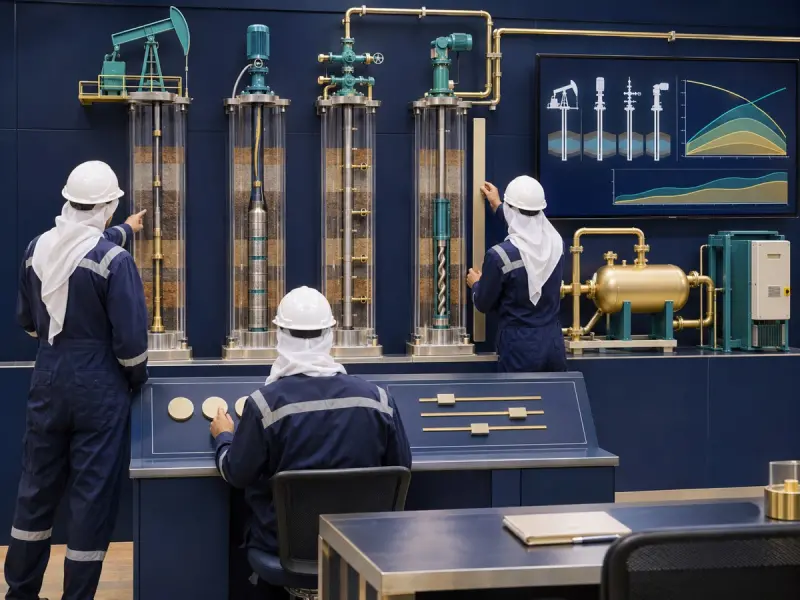
Advanced Gas Lift Design, Optimization and Troubleshooting Training Course

Course Details
-
# 2035_249598
-
22 March – 2 April 2027 02.Apr.2027
-
Cairo
-
8500 €
Overview
Advanced Gas Lift Design, Optimization and Troubleshooting Training Course is a two-week course for production engineers, artificial-lift specialists, well-performance teams, and operations personnel who leave with a Gas Lift Design and Field Performance Decision Pack. Participants connect well performance, valve mechanics, unloading design, injection depth, surveillance, allocation, integrity, and diagnostics. The course converts pressure, rate, survey, and equipment evidence into traceable operating decisions. Agile Leaders Training Center presents this course on advanced gas lift design and optimization.
Who Should Attend
- Teams responsible for production engineering and well performance
- Functions responsible for artificial-lift selection and design
- Personnel responsible for gas lift operations and surveillance
- Groups responsible for completion equipment and well integrity
- Teams responsible for field optimization and production allocation
The course assumes participants can interpret well pressure, rate, completion, and production data at work; it leaves out introductory petroleum engineering and vendor-specific software operation.
Departments and Industries
The course supports departments and industries that design, operate, or monitor gas-lifted production systems.
- Oil and gas operating companies
- Production technology and well-performance teams
- Artificial-lift and completion service companies
- Operations, maintenance, and integrity functions
- Engineering consultancies and technical service groups
- Energy production and processing organizations
Learning Objectives
By the end of this course, participants will be able to:
- Analyze inflow, outflow, and gas lift performance
- Build valve-spacing and unloading designs
- Evaluate injection depth and equipment choices
- Optimize well and field gas allocation
- Use surveillance evidence to diagnose underperformance
- Prioritize integrity and troubleshooting actions
Course Agenda
Day 1: Analyze the Gas Lift System
- Artificial Lift Method Selection Matrix
- Continuous and Intermittent Gas Lift Comparison
- Well Inflow Performance Relationship Curve
- Vertical Lift Performance Curve
- Operating Envelope Assumption Register
Day 2: Model Well Performance
- Nodal Analysis Workflow
- Gas Lift Performance Curve
- Injection Rate Sensitivity Plot
- Tubing Pressure Traverse Model
- Injection Depth Feasibility Map
Day 3: Select Equipment and Configuration
- Surface Injection Equipment Map
- Mandrel and Valve Configuration Sheet
- Injection and Production Pressure Valve Comparison
- Orifice and Port Sizing Method
- Equipment Compatibility Checklist
Day 4: Design the Unloading Sequence
- Kickoff Pressure Calculation Sheet
- Valve Spacing Design Plot
- Unloading Sequence Pressure Chart
- Test-Rack Opening Pressure Worksheet
- Operating Valve Selection Record
Day 5: Build the Gas Lift Design
- Design Input Validation Checklist
- Design Pressure and Temperature Profile
- Injection Point Selection Matrix
- Valve Setting Calculation Pack
- Gas Lift Design Review Gate
Day 6: Optimize Well Injection
- Multi-Rate Injection Test Plan
- Production Response Curve
- Optimum Injection Rate Decision Model
- Compressor Constraint Allocation Sheet
- Well Optimization Action Register
Day 7: Allocate Gas Across the Field
- Field Gas Availability Balance
- Well Opportunity Ranking Matrix
- Incremental Production per Gas Curve
- Multiwell Gas Allocation Model
- Field Optimization Scenario Board
Day 8: Interpret Surveillance Evidence
- Flowing Gradient Survey Interpretation
- Surface Pressure and Rate Trend Dashboard
- Annulus-Tubing Communication Diagnostic Tree
- Injection Profile Verification Checklist
- Surveillance Exception Register
Day 9: Diagnose Integrity and Performance
- Multipoint Injection Diagnostic Map
- Heading and Instability Cause Tree
- Valve Leak and Cutting Evidence Matrix
- Insufficient Injection Pressure Assessment
- Integrity Intervention Decision Record
Day 10: Practice Gas Lift Decisions
- Suggested Exercise: Design an Unloading Sequence
- Suggested Exercise: Optimize a Well Injection Rate
- Suggested Exercise: Allocate Gas Across Wells
- Suggested Exercise: Diagnose an Underperforming Installation
- Capstone Exercise: Present a Gas Lift Design and Field Performance Decision Pack
Practical Exercises
The course uses suggested activities to turn pressure, rate, survey, and equipment evidence into gas lift decisions.
- Suggested activity: model inflow, outflow, injection depth, and the unloading sequence for a producing well.
- Suggested activity: compare valve, mandrel, port, and setting choices against design constraints.
- Suggested activity: allocate limited lift gas using well response curves and compression limits.
- Suggested activity: diagnose instability, multipoint injection, leakage, and insufficient injection pressure from field evidence.
FAQs
Who suits advanced gas lift design and optimization training, and what does it assume?
Production engineers, artificial-lift specialists, well-performance teams, completion personnel, and operations staff suit the training. It assumes practical ability to interpret well and production data.
How does advanced gas lift design differ from an artificial-lift overview course?
Advanced gas lift design develops valve, unloading, injection, surveillance, allocation, and diagnostic decisions for gas-lifted wells. An artificial-lift overview usually compares lift methods without the same design depth.
How is gas lift injection depth selected?
Injection depth is selected by comparing available injection pressure, well pressure profiles, valve spacing, unloading requirements, equipment limits, and the deepest feasible operating point.
How is lift gas allocated across multiple wells?
Lift gas is allocated by comparing incremental production response, well constraints, injection-rate sensitivity, compression capacity, operating stability, and field priorities within a documented allocation model.
How are gas lift problems diagnosed?
Gas lift problems are diagnosed by combining surface trends, flowing-gradient evidence, injection tests, pressure relationships, valve behavior, operating history, and integrity indicators in a structured diagnostic tree.
Conclusion
Participants take a Gas Lift Design and Field Performance Decision Pack back to their organization. It connects performance models, valve design, unloading, optimization, surveillance, allocation, integrity, and diagnostic evidence. Teams can use the pack to document design assumptions, compare injection choices, and prioritize operating or intervention actions for gas-lifted wells.
Oil & Gas Training and Other Technical Courses
Gas Lift Design and Optimization Training Course (2035_249598)
Course Details
# 2035_249598
22 March – 2 April 2027
Cairo
Fees : 8500 €
Advanced Gas Lift Design, Optimization and Troubleshooting Training Course runs in Cairo over 12 days, with 1 upcoming date in Cairo. The course fee is 8,500 €.
All dates in Cairo
| Dates | Price | Actions |
|---|---|---|
| 22 March – 2 April 2027 | 8,500 € | Register |
Training in Cairo
Join us in the historic city of Cairo, Egypt, and enrich your knowledge with our industry-leading training courses.
All courses in CairoThis course in other cities
- Abu Dhabi
- Accra
- Addis Ababa
- Amman
- Amsterdam
- Athens
- Baku
- Bali
- Bangkok
- Barcelona
- Berlin
- Cape town
- Casablanca
- Chicago
- Doha
- Dubai
- Frankfurt
- Geneva
- Istanbul
- Jakarta
- Johannesburg
- Kuala Lumpur
- Kuwait
- Lagos
- Langkawi
- Lisbon
- London
- Madrid
- Manama
- Marbella
- Milan
- Montreux
- Munich
- Muscat
- Nairobi
- New York
- Nice
- Paris
- Phuket
- Porto
- Prague
- Rome
- San Diego
- Seoul
- Sharm El-Sheikh
- Singapore
- Tashkent
- Tbilisi
- Tokyo
- Toronto
- Trabzon
- Vienna
- Zanzibar
- Zoom