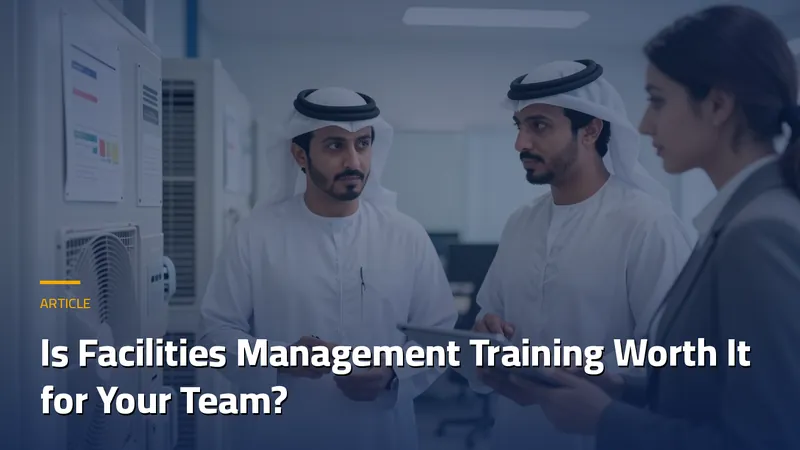
Facilities management training earns its place on a training budget when the person taking it already owns part of a building, a site, or the vendors who keep it running. It will not turn a complete outsider into a facilities manager overnight, but for someone already doing the job informally, it replaces guesswork with a system: measurable service levels, a maintenance plan instead of a repair list, and contracts that actually hold suppliers to account. The clearest winners are property and estates managers, operations supervisors, and anyone who has quietly become "the building person" on top of their real job title.
What will you be able to do afterwards?
Good facilities management training is practical by design. It is built around the tasks a facilities manager actually does in a working week, not theory. After it, you should be able to:
- Read a mechanical or HVAC maintenance report and ask the right follow-up questions, instead of taking a contractor's summary at face value.
- Set up a preventive maintenance schedule for core building systems, so repairs are planned rather than urgent.
- Write and enforce a vendor service level agreement with terms you can actually measure and act on.
- Plan space and floor usage when a team grows, a department moves, or a lease needs renegotiating.
- Run a structured process for tenant or occupant complaints, rather than handling each one from scratch.
- Put together a basic continuity plan for the building and facilities side of the business.
None of this requires an engineering background. It requires knowing which questions to ask the people who do the technical work, and how to hold a contract or a budget to the standard the business needs.
Who is it for, and who is it not for?
Who it's for
This training fits property and facilities managers overseeing office buildings, corporate campuses, or retail space; estates supervisors handling tenant relationships and lease conditions; and mechanical, electrical, or plumbing (MEP) supervisors stepping up into a management role where they now own a budget and a set of contracts, not just the equipment.
Who it's not for
Skip it if nobody has handed you responsibility for a building, a maintenance budget, or a vendor relationship yet — the course assumes you will apply what you learn to a real site straight away. It is also not the right starting point if you are looking for hands-on trade skills in electrical work, plumbing, or HVAC repair; facilities management training is about governing and coordinating that work, not performing it yourself.
How do you apply facilities management skills at work?
Take a common situation: a regional office manager inherits responsibility for three floors of leased space after a reorganisation. Maintenance requests have been going straight to the landlord's helpdesk with no record of what was fixed, how long it took, or what it cost the business in disruption. Meeting rooms are double-booked because nobody owns the floor plan, and the cleaning contractor's scope was agreed over email a long time ago and never reviewed since.
With facilities management training behind them, that manager's first move is not technical — it is structural. They pull the cleaning and maintenance contracts and rewrite the vague ones into service level agreements with defined response times and a way to check whether the contractor is meeting them. They set up a simple preventive maintenance calendar for the HVAC and life-safety systems that matter most, so the landlord's helpdesk stops being the only line of defence. They redo the floor plan against actual headcount, free up the meeting rooms, and build one short process for logging and escalating occupant complaints, so the same issue is not reported five times before anyone owns it.
None of that needs a facilities engineering degree. It needs the habits and vocabulary the training builds — reading a contract for what it actually commits a vendor to, planning maintenance instead of reacting to it, and treating the workplace as something to be managed rather than tolerated.
Which facilities management course fits your situation?
Not every facilities role needs the same depth. A few starting points, depending on where you sit:
If you are moving into a broad facilities management role and need the full operational picture — maintenance, vendor oversight, space planning, and building operations in one place — the Facilities Management Professional Training Course builds that foundation for people managing commercial premises day to day.
If you want a wider sweep that also covers compliance, risk, and business continuity alongside the operational basics, the Mastering Facilities Management: A Complete Training Course is built around that broader governance side of the role.
If your goal is a recognised credential rather than a general refresh, the Comprehensive Facility Management Exam Prep Training Course is structured around certification exam preparation, alongside the operational and financial topics the exam covers.
And if you already run facilities day to day but need to professionalise how you document and report on it — standard operating procedures, KPI reporting, and stakeholder communication — Facility Operations Mastery: SOPs, KPIs and Stakeholders focuses specifically on that operational reporting layer.
Bottom line: facilities management training is worth it once the job already involves a building, a budget, or a vendor you need to manage — it turns that responsibility into a repeatable system instead of a constant reaction. It is not worth it as a first step into the trade itself, or for someone with no real authority over a site. Check the course page for the full syllabus, upcoming dates and fees.
Frequently asked questions
Does facilities management training cover technical repair skills?
No. It focuses on planning, vendor management, and oversight — the technical repair work (electrical, plumbing, HVAC) stays with specialist trades and contractors.
Do I need an engineering degree to benefit from this training?
No. The training is built for people who manage buildings and the people who maintain them, not for people performing the technical maintenance themselves.
Can someone with no facilities experience start here?
It works best for someone who already has some responsibility for a building, budget, or vendor, even informally. Without that, the material has nothing real to attach to yet.
How is facilities management different from property management?
Property management tends to focus on tenants, leases, and occupancy, while facilities management focuses on keeping the building's systems, maintenance, and vendor contracts running. Many roles combine both.
Will this help with vendor contract negotiations?
Yes. A recurring theme across the courses is writing and enforcing service level agreements, which directly affects how vendor contracts are negotiated and managed.
Is one course enough, or should I combine them?
Most people start with one course that matches their current gap — operations, certification, or reporting — and add another later if their role expands.